TITLE OPTIONS (choose one):
-
When AI makes all your decisions, you are overdrawing a “decision debt” you can never repay ⭐ RECOMMENDED Reason: Introduces the core exclusive concept of “decision debt,” creating a sense of urgency and suspense. It cuts directly into modern people’s hidden anxiety over AI dependence, driving high click-through desire.
-
In an era of millisecond responses, humanity’s supreme privilege is to “declare a pause” Reason: Highly philosophical and counter-intuitive (machines seek speed; humans seek slowness). Directly identifies the article’s core breakthrough point. Suitable for a high-cognition audience.
-
Algorithms know every optimal solution, but will never understand “why you started” Reason: Aims for emotional and value-based resonance. Contrasts cold algorithms with warm humanity, prompting reflection on the meaning of life.
-
Is your “decision muscle” atrophying? Defend the line against AI’s dimensionality reduction strike! Reason: Action-oriented and urgent. “Atrophying” and “dimensionality reduction strike” are strong, gripping terms for social media.
IMAGE PROMPTS (copy to nano banana):
-
[FATHER & DAUGHTER DECISION Style] ⭐ RECOMMENDED Description: Hyper-realistic photography style combining family warmth with extreme high-tech aesthetics. A cozy late-night home study (solid wood desk, warm yellow desk lamp, steaming hot tea). In the center of the frame, a twelve or thirteen-year-old girl sits at the desk. Projecting onto the desk is a massive, intricate, ice-blue holographic “AI Decision Tree” (filled with countless glowing paths, probability metrics, and “optimal solution” markers). The girl holds a physical metal pen (or baton) in her hand, preparing to make the final “choice.” Behind her, a father leans slightly forward with a smile. He does not press those floating codes for his daughter; instead, his large, warm hands gently hold/wrap around the daughter’s hand holding the pen. In this moment, the father is passing on “the courage to bear the weight of a choice.” The visual tension of the image lies in the intense collision between the extremely exaggerated, cold, and complex AI holographic network and the profoundly warm, rustic, and authentic father-daughter inheritance.
English Prompt: Hyper-realistic, cinematic photography combining intense high-tech visuals with profound family warmth. A cozy late-night home study (wooden desk, warm amber lamp light, a steaming mug of tea). In the center, a 12-year-old girl sits at the desk, looking at a massive, complex, glowing ice-blue holographic “AI Decision Tree” projecting from the desk surface, filled with infinite glowing paths, probability numbers, and “optimal solutions”. The girl holds a real, physical metallic stylus (or baton), poised to make the final “Choice”. Standing behind her, a smiling father leans forward. He is not pressing the buttons for her; instead, his large, warm, weathered hands gently wrap around or support her hand holding the stylus, passing on the courage to decide. Ultimate visual tension: the cold, overwhelmingly complex AI holographic web vs. the warm, grounding, authentic human connection between father and daughter.
-
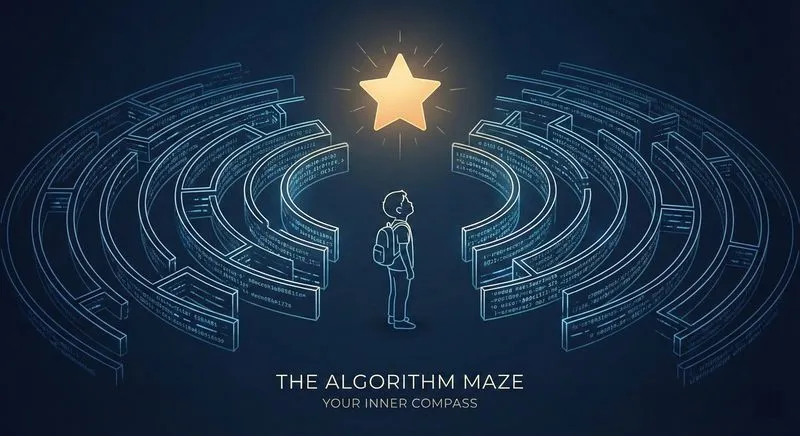
[KINDERGARTEN MAZE Style] Description: Minimalist conceptual art illustration. A massive, intricately complex labyrinth constructed of glowing digital code and data streams. Right in the absolute center of the maze stands a tiny child wearing a backpack. The child is not looking at the complex paths of the maze; instead, they are looking straight up at the sky, where a warm, golden guiding star shines (representing inner values and the centerline). The image conveys the metaphor: “AI can give you countless complex paths, but only you can decide the direction of your heart.” Highly metaphorical, suited for an audience of parents.
English Prompt: Minimalist conceptual art illustration. A massive, complex labyrinth made entirely of glowing digital code and data streams. Right in the absolute center stands tiny silhouette of a child wearing a backpack. The child is not looking at the complex paths, but is looking straight up at a warm, bright golden guiding star in the dark sky (representing inner values and Chushin). Metaphorical style: “AI gives paths, but humanity gives direction.”
-
[WOODEN TOY Style] Description: Hyper-realistic macro still life. On a cold, high-tech glass desk, two items create a stark contrast: on the left, an avant-garde transparent smartphone rapidly calculating complex AI decision trees on its screen; on the right, a rustic, warm, well-worn wooden toy sword (or wooden blocks representing childhood), showing the patina from a child’s grasp. The ultimate contrast between cold vs. warm, the extreme speed of algorithms vs. the authenticity of humanity.
English Prompt: Hyper-realistic macro still life. On a cold, high-tech glass desk, two items create a stark contrast: on the left, an avant-garde transparent smartphone rapidly calculating complex AI decision trees on its screen; on the right, a rustic, warm, well-worn wooden toy sword (or wooden blocks), showing the patina of a child’s grasp. The ultimate contrast between the cold speed of algorithms and the warm authenticity of humanity.
ARTICLE CONTENT:
When AI Makes All Your Decisions, You Are Overdrawing a “Decision Debt” You Cannot Repay
When algorithms not only write your code but also plan your itineraries, screen your partners, and map out your life trajectory, you are surrendering the most hardcore right of being human. AI handles the computation, but you must personally grip the sword named “Choice.”
Late the night before last, I stared blankly at my screen.
A report that should have taken me days to conceptualize was spat out by an AI as a near-perfect framework in half a minute. The logic was rigorous, the phrasing was precise, and even the distribution of potential risks was exhaustively mapped.
I let out a long breath and picked up my now-cold coffee. But in that split second, I was struck by an indescribable chill.
If all thinking is seamlessly hijacked like this, what will be left of my deep judgment in two years? What about five years? If my daughter grows up entirely in a sterile environment where “every question yields a perfect answer,” how severely will the “neural muscle” she needs to navigate the real world atrophy?
Today, as artificial intelligence becomes capable of handling nearly all cognitive computation, a terrifying paradox is emerging:
As machines become increasingly “smart,” the “decision-making capacity” that serves as humanity’s final trump card is collectively atrophying in a stealthy manner.
When the cost of acquiring information drops to zero, and algorithms not only build your spreadsheets but also arrange your blind dates, screen your partners, and even plan your career trajectory for the next five years… we must re-examine a piercing question: Behind that thick stack of model outputs, what power remains exclusively yours as a creature of flesh and blood?
01. Algorithms Give You the Answer, But Only You Determine the Direction
Those who treat AI as a deity often conflate two distinct concepts: “Reasoning” and “Choosing.”
AI’s domain is reasoning. It can construct overwhelmingly complex logical structures based on historical data to calculate the “optimal solution” within a probability space. But it has a fatal blind spot: it can never comprehend your “fundamental parameters.”
It does not know:
- What kind of person do you genuinely want to become?
- Which outcome aligns with your deepest core values?
- Which path will leave you without regret when you look back a decade from now, even if you fail?
An algorithm’s optimal solution is statistical success; Your optimal solution is a life without regret measured by your values.
AI can accurately tell you “How” to do something, but it can never answer “Why” you embark on the journey.
In mathematics, the optimal solution is singular. But in the wilderness of life and real business, “direction” is a uniquely human privilege. Letting an algorithm find the path for you is efficient; letting an algorithm decide your destination is tragic.
Direction can be recalibrated; but once one particular thing is lost, the damage is almost irreversible—
02. Warning: Your “Decision Muscle” is Quietly Atrophying
At “Yinian” (One Thought)—a thought laboratory that integrates decision science with the philosophy of Kendo—we never treat decision-making as an ethereal wisdom. We treat it as a neural muscle that requires continuous resistance training (the prefrontal cortex).
Here, the law of muscle applies: use it or lose it.
In the AI era, the greatest systemic risk we face is not machines stealing our jobs, but the excessive delegation of decision-making authority to algorithms.
Every time you hand a choice over to an algorithm, you overdraw a “decision debt.”
When you grow accustomed to letting systems dictate what news you read, what music you listen to, what you buy, or even copy-pasting AI-generated, “high-EQ” responses to your boss and your partner… you think you are embracing high-tech and conserving energy.
In reality, you are frantically accumulating decision debt.
Like a frog in boiling water, every time you mindlessly click “accept suggestion,” your prefrontal cortex misses out on forging a crucial synaptic connection. Long-term “outsourcing” of your choices guarantees a physiological degradation of your decision-making system. One day, when the algorithmic crutch is suddenly kicked away, or when you face a life-and-death scenario that AI cannot exhaustively compute, you will realize with horror: you have lost even the intuition to take the first step.
Zillow’s $500 million lesson is the ultimate real-world manifestation of “decision muscle atrophy.”
Zillow, the largest real estate platform in the U.S., once utilized AI algorithms to forecast housing prices and execute massive, direct home purchases. During the bull market, the algorithm minted money daily. The executives, mistaking this for their own brilliance, continually expanded the budget, fully surrendering hundreds and thousands of million-dollar transaction decisions to the machine.
Then came the inflection point. In the second half of 2021, the real estate market underwent a rare yet subtle shift. Normally, seasoned traders would have smelled the danger just by visiting the market in person. But algorithms don’t have noses. They only read historical data. Convinced that prices would continue to rise, the algorithm kept sweeping up properties at a frantic pace. Meanwhile, the executives—who had long ceased making frontline decisions and only looked at reported models—had severely atrophied decision muscles. The algorithm couldn’t see the crisis coming, and therefore, neither could they.
It wasn’t until months later, when the bubble burst, that the company lost $500 million, laid off 2,000 employees, and completely shuttered the business line. In this catastrophic failure, Zillow didn’t lose to an algorithm; they lost to their own compounded “decision debt.”
When a moment of true chaos arrives, there are no prompts to use and no historical data to reference. Those executives, spoon-fed by algorithms for so long, realized in despair that they had entirely lost their judgment, their intuition, and the courage to bear the consequences.
03. Solidifying “Thought” into Physical “Instinct”
When AI instantly pops up a “perfect solution,” why is it so hard to resist?
Nobel laureate in economics Daniel Kahneman revealed in Thinking, Fast and Slow: the human brain operates on two systems. System 1 (fast thinking) relies on intuition, operating automatically with almost zero effort; while System 2 (slow thinking) demands intense focus and burns massive amounts of energy.
Today, with the ubiquitous presence of AI, the model has become an omniscient “externalized System 1.” It uses effortless, extreme-speed computation to seduce us into surrendering the sovereignty of our brains. Once you grow accustomed to this outsourcing, your “System 2”—starved of rigorous resistance training—faces total atrophy.
However, in a real, chaotic game, what truly saves your life is never a randomly generated solution on a screen, but the forged-in-fire intuition and instinct within your body.
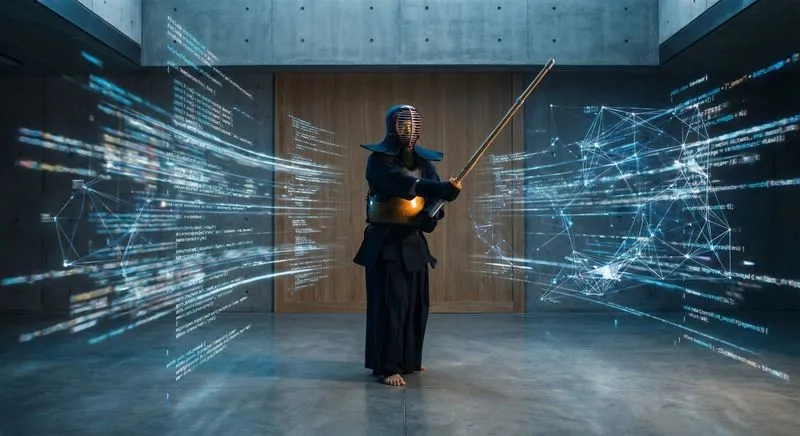
In a life-or-death Kendo match, when your opponent strikes at your face, you have absolutely no time to boot up your brain’s “System 2” to slowly evaluate the pros and cons of each tactic. Under extreme pressure, choosing the next strike must rely entirely on physical instinct.
But this is by no means reckless bravado. In top-tier duels, this lightning-fast instinct must be built upon thousands of tedious, clumsy swings practiced in the dojo. During those slow-motion training sessions, with every single swing, you must hyper-focus your “System 2” to repeatedly calibrate your footwork, the tip of your sword, and your mindset, ensuring you relentlessly guard the Centerline (Seichusen) between you and your enemy.
This is the truth of the decision muscle: you must use countless, extremely energy-intensive “slow thoughts” to train and calibrate this neural pathway—your “values and centerline”—amidst uncertainty, until it forms the densest possible synapses and becomes your “fast instinct” the moment you draw your sword.
When the rule of “holding the centerline” is thoroughly mastered and becomes pure physical memory, no matter how chaotic the external storm or how many seemingly reasonable frameworks an algorithm throws at you, your body will instinctively cut through the noise and deliver the most fatal strike.
04. Conclusion: Hold Your “Centerline”
AI is a phenomenal tool, but it is never the helmsman. Its function is to hack away 99% of the thorns and reveal a broader horizon, not to blindfold you as you navigate the world.
At Yinian, we never teach you to reject or fear AI. We teach you how to see the limits of data and, within the deafening jungle of algorithms, how to hold the “Centerline” (Seichusen) of your values.
In future articles, we will systematically unpack a comprehensive “Decision Muscle Training Protocol”—from how to identify core signals and locate asymmetric leverage points, to building your margin of error.
AI is responsible for gathering, organizing, reasoning, and exhausting possibilities; But the final verdict, that definitive choice made in a single thought, must be executed by your own warm hands.
The future is not AI replacing humans; it is AI replacing humans who have abandoned thinking.
At Yinian, we believe: decision-making capability is your ultimate weapon in an era of chaos.
Welcome to the algorithmic age. Now, grip tightly the sword in your hand named “Decision.”
[ A Moment of Zanshin ] When was the last time you rejected the “optimal solution” provided by AI (or an expert) and stood by your own intuition? Feel free to share your “one thought” in the comments section.