We have reached the point in this series where we have covered over twenty articles. On this journey—neither overly long nor particularly short—we have deconstructed several thrilling business cases together. We watched Satya Nadella pull the δ circuit breaker with a cold detachment while everyone else was shouting for “Microsoft’s surrender”; we accompanied Pony Ma as he relied on absolute base rates P(C) and foundational error-correction capability A to grow WeChat, after enduring a decade of being vilified across China; we observed how Shein found a destructive asymmetrical fulcrum S, smashing ZARA’s physical fast blade into scrap iron; we dissected Pinduoduo’s machine that generated overwhelming noise N, causing a collective short circuit at Alibaba and JD.com; and we closely examined Pang Dong Lai’s Yu Donglai and his “unwavering mind” that completely zeroed out the interference of fear E.
Now, it is time to assemble the fragments scattered across these top-tier business battles into a complete blueprint.
Blind Spot Bias: Do You Truly Possess “Free Will”?
Before revealing the final card, I must ruthlessly puncture a shared human illusion. Within the “Decision-Making Operating System,” this illusion is called the Blind Spot Bias—you always believe others are brainwashed and drifting with the tide, while you alone are awake, and every choice you make stems from “free will.”
Is that true? Dig up the major decisions you have made throughout your life and take a look: That college major you worked yourself to the bone for—was it because you loved it from the bottom of your heart, or because your parents and relatives told you it was “easy to find a job” in that field? The job you are currently doing, which makes you want to quit ten thousand times a day—is it because you want to change the world through it, or because the social clock has you by the throat, telling you: “At your age, you can’t afford to take risks anymore”? The apartment you took out a mortgage for, the luxury bag you gritted your teeth to buy, or even the marriage partner you chose because they seemed like a “decent match”… What percentage of these choices truly came from your soul’s deepest desires? And what percentage was orchestrated by consumerist advertising, social comparison, and algorithms tailor-made to tell you what “you ought to have”?
Even in trivial daily matters, like going out to eat on a weekend—do you spend half an hour scrolling through ratings on review apps, anxiously comparing discount logic, terrified that in this highly quantified world, you might make a decision that isn’t the “optimal solution”?
In this era, hermetically sealed by big data, recommendation algorithms, omnipresent KPIs, and societal judgment, you think you are making choices. In reality, you are merely a fleshy actuator executing commands inputted by others. Our “free will” is pathetically fragile.
If you cannot even see the cognitive biases and emotional demons that have been secretly manipulating you, how do you prove you are still a living human being? On what grounds can you claim your choices are your own, rather than a pile of cold code and bias pressing the Enter key through your hand?
The reason we study this system—a fusion of Nobel-level operations research and Kendo philosophy—is not to become a machine that always selects the “highest expected value,” nor is it to destroy someone in a business war. It is so that, even if the sky falls and the earth shatters, we can firmly grip the steering wheel of our own destiny.
Your “Life Decision Equation”
Now, close your eyes. Imagine your brain is a sophisticated computer. At the conclusion of this column, I am officially writing this foundational decision-making architecture—one that can guide you through all the fog—into your system. This is, in fact, a precise five-layer verification model (due to the depth of the content, we will conduct a whiteboard-level deductive breakdown of the complete equation and the logical interplay between variables in our upcoming core offline closed-door course).
This is not merely a tool for corporate combat. It is a “sandbox simulation” model you will use to hedge downsides and clear minefields when facing future promotions, entrepreneurship, marriage, or even buying a house. When you can proficiently invoke these five dimensions of verification, all the fog, scams, and gaslighting will instantly melt away like snow under the sun.
(Regarding how to use this model to diagnose your specific business dilemmas, we will conduct in-depth, whiteboard-level practical deductions in the core offline closed-door course.)
A few days ago at dinner, a very minor incident occurred.
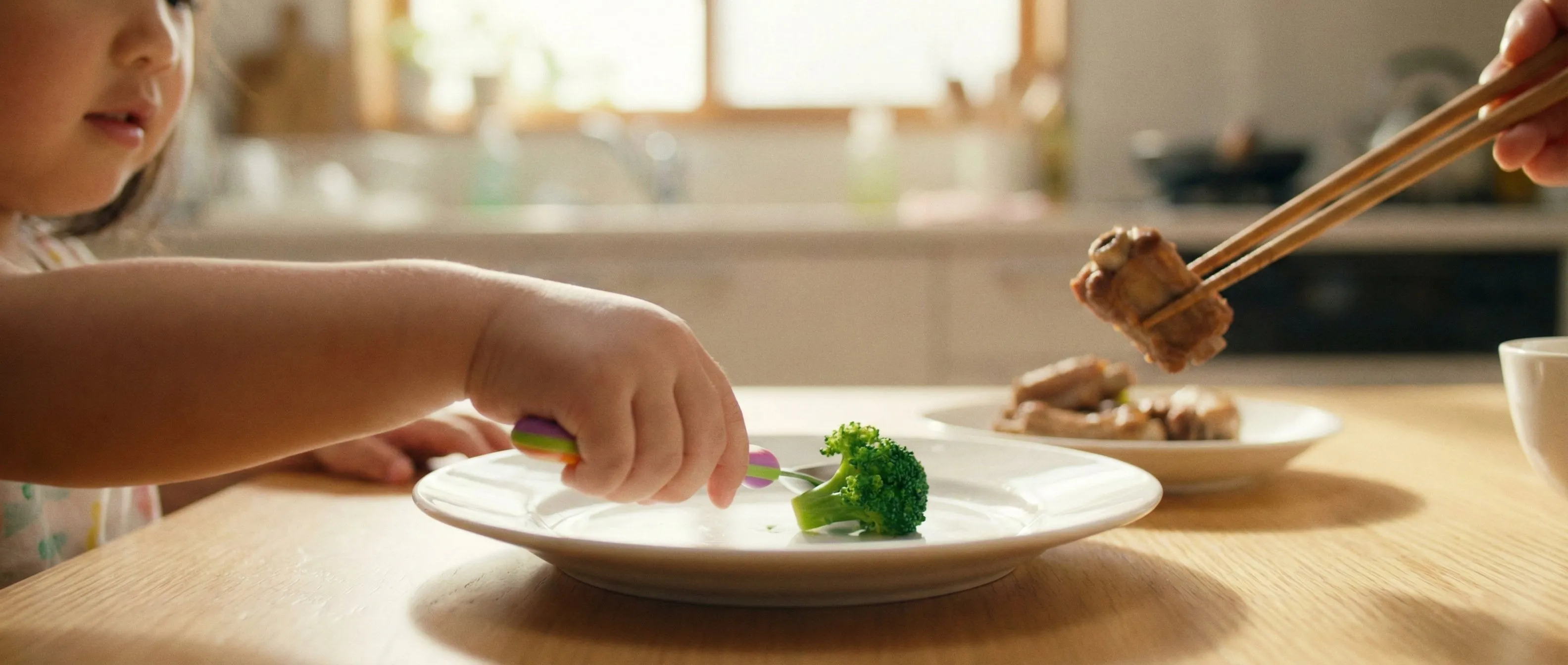
My four-year-old daughter was sitting in her high chair. Looking at the dishes on the table, I relied on a grown man’s confident judgment of “nutrition” and “taste” to pick up a tender, juicy piece of pork rib. I placed it in her bowl and said, “Sweetie, eat this. It’s delicious.”
But this little tyrant stubbornly stretched out her chubby hand and pushed the meat away. She grabbed a plastic spoon, awkwardly and shakily reaching for a piece of… overcooked, yellowed, plain-boiled broccoli sitting in the corner of the plate.
That broccoli was absolutely not delicious; it completely failed the algorithm of “maximizing taste bud utility.” But when she finally managed, with tremendous effort, to shove that mushy vegetable into her mouth—
Her eyes shone with a pure, irrefutable light.
Watching her chomp away, the chopsticks in my hand paused. In that moment, my daughter was not conducting a cost-benefit analysis, nor was she evaluating the S leverage of this meal. She was simply dead set on choosing that broccoli. Because it was “her own choice.”
She wasn’t choosing a vegetable; she was exercising every ounce of autonomy in her little life to loudly declare to the world—and to her father—that this was her will. At that moment, there was no anxiety (E approaches 0), and no external noise (N approaches 0). There was only intrinsic joy and ease.
When a true master wields this decision equation to draw their sword, they do not look ferocious, calculating through gritted teeth. Quite the opposite. When we strip away all the noise, empty out all the fear, and eliminate all the fatal traps— The final strike of that sword is exquisitely light.
Just like that four-year-old child, bypassing all obstacles and ignoring all the “better options” shoved at her by others.
We learn various cold analytical frameworks, build defense lines, and endure agonizing cognitive detachment training. Not to turn life into a ruthless arena of petty calculation. We train so rigorously, swinging the sword inward time and time again, so that one day, amidst overwhelming systemic pressure, we can calmly and easily say to ourselves:
“I know the algorithm can give me a ‘more cost-effective’ answer.” “But today, I insist on choosing this broccoli.”
Draw your sword. Not to strike at others. But to sever the internal noise and reclaim your throne.
Welcome home, swordsman.